
Reasoning with less text
HybridAgent combines latent computation with text-based tool use. The useful questions are what it saves, what remains observable, and what it takes to run.
A research agent is asked to find two published figures, calculate their ratio, and cite the sources. It needs to search, use the right inputs, perform a calculation, and explain the result. A text-based reasoning process may also generate many intermediate sentences along the way.
Those sentences give the system a way to work through the problem. They also take time to generate. The question is whether every intermediate step needs to become a word before the agent can continue.
The October 2026 preprint Hybrid Reasoning Agents explores alternating latent computation with text interaction. The useful distinction is between how an agent computes and how it communicates with tools and people.
What changes inside the agent
Language models already compute with hidden numerical representations. Latent reasoning makes those representations the inputs to further reasoning steps, without first decoding them into words. Earlier work such as Coconut investigates that approach by feeding a model's hidden state back as its next input.
HybridAgent adds a learned adapter, HybridLink, that maps hidden states into the input-embedding space. The agent can switch into latent mode, then return to text for a tool call or answer. Its working context includes text, latent states, and tool observations. The released implementation preserves that context across turns through the model's attention cache, rather than rebuilding it from a transcript.
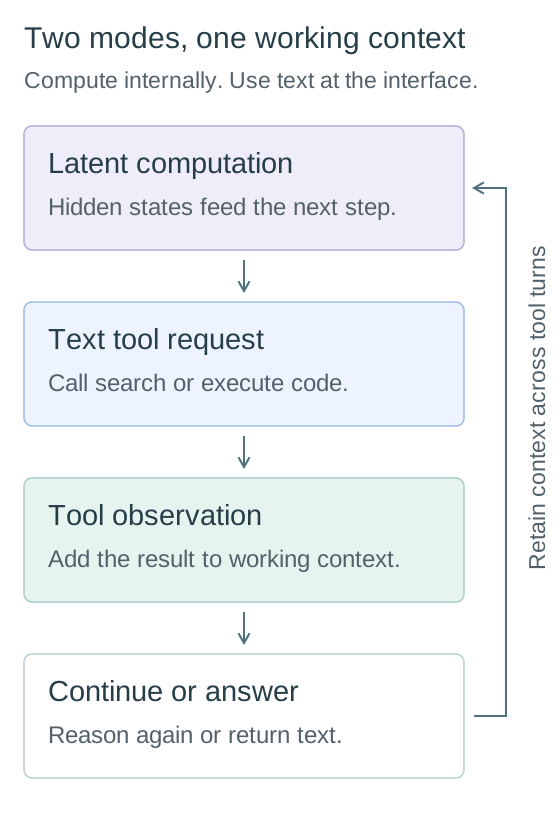
This is a model and runtime change. Asking an ordinary chatbot to be concise changes what it writes; it does not give the application access to this hybrid computation path. The repository includes dedicated inference and training components, including supervised fine-tuning and reinforcement learning, as well as a latent-state inspector. We inspected the implementation, but have not run or reproduced its training.
The distinction from learning from business use is important. Here, working context supports the current task. It is not, by itself, a lesson retained for next week's tasks.
Read the comparisons separately
Table 1 compares 14B HybridAgent with ARPO, a text baseline using the same backbone family and RL data. The chart shows three reported aggregate scores. These are author-run benchmarks. Results and setup
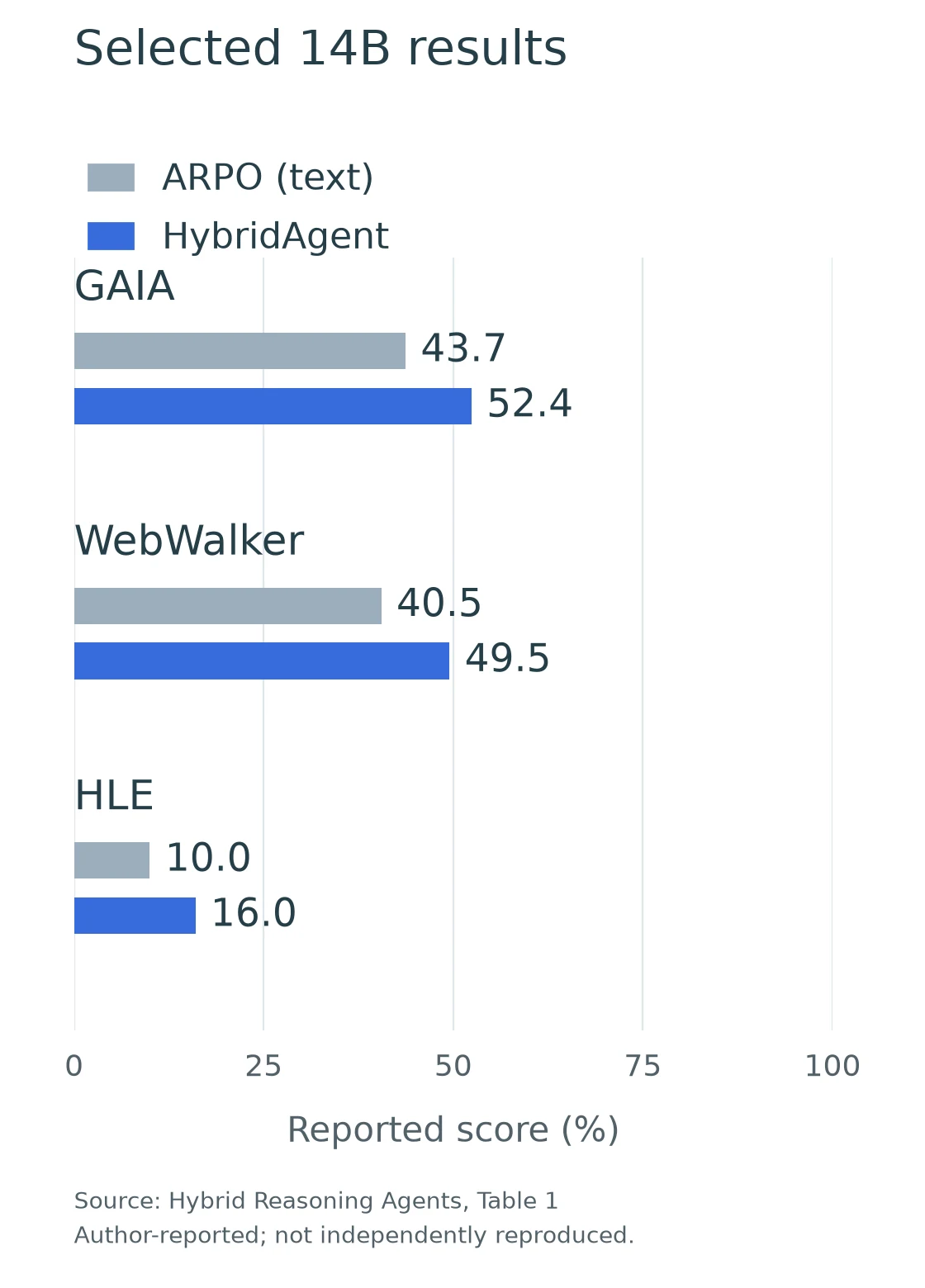
The result is worth investigating because the comparison controls more of the setup than a ranking of unrelated commercial models would. It still compares complete trained methods. The chart alone cannot tell us how much of the gain comes from each architectural or training decision.
The cost headline needs a different reading. Appendix G.2 estimates generation costs at $2.50/H100-hour and 10% of peak BF16 throughput. It excludes prompt processing, context-dependent attention, and external tool execution. These are modeled costs, not API bills. Cost analysis
For a real research workflow, elapsed time also includes searching, waiting for external services, and recovering from failures. Faster internal generation helps only the portion of the job it changes. A task dominated by a slow source website may see a very different benefit from a task dominated by model computation.
We would therefore measure the time and cost of reaching an accepted answer, including retries and tool calls. Counting fewer emitted words would leave too much of the work unmeasured.
Readable traces still need a test
The implementation can render latent states as pseudo-text by finding nearby token embeddings. That provides an inspection surface, but a readable rendering alone does not establish a complete or faithful account of the computation. Latent inspector
The authors evaluate visible-trace monitoring and debugging on 560 mathematics problems. That is the scope of this test. Auditability evaluation
A business workflow raises additional questions. Can a reviewer identify the source used for a consequential figure? Can the system explain which tool action changed a record? Does the trace distinguish a proposed action from one that actually completed?
These questions are not settled by the trace looking coherent. Research on chain-of-thought monitorability treats written reasoning as a useful but imperfect oversight channel, and warns that its usefulness can be affected by model-development choices. Changing the medium of computation makes that channel something to evaluate explicitly.
For the two-figure research task, we would want the source passages, the extracted values, the calculation input and output, and the final citation. Those observations let a reviewer check the answer without assuming that a fluent narrative reveals everything that happened internally.
That connects directly to completion evidence. The reasoning method can change while the requirement to verify the resulting actions and answer remains.
The serving system becomes part of the decision
The implementation's dependence on retained numerical context has consequences beyond model accuracy. A text transcript can be stored, inspected, and supplied to another model. A saved hybrid state needs a compatible way to restore the numerical part as well.
That suggests several practical tests for an engineering team considering this approach. Interrupt a task and check whether it resumes correctly. Measure the memory needed while many tasks are active. Check what the system can preserve when a model or runtime version changes. Establish which observations remain available when a run fails.
These are deployment questions to investigate, not failures demonstrated by the paper. They matter because an inference improvement has to survive the surrounding system to become a useful product improvement.
For the research agent, the acceptance target stays concrete: the right two figures, a correct ratio, and sources someone can check. Hybrid reasoning offers a different way to reach that result. Its value will depend on whether the full workflow reaches it faster or more cheaply while preserving the evidence needed to trust it.