
Is an AI project worth the cost? A worked business case
Calculate AI project ROI with a worked example covering adoption, human review, integration, running costs and the difference between capacity and cash savings.
An AI project is worth funding when a plausible improvement to the whole workflow justifies its implementation and operating costs. The calculation needs to include the work people still do: checking suggestions, correcting mistakes, handling exceptions and keeping the system useful.
I would begin with one recurring task and a business owner who can explain what released time would be used for. A faster draft has limited financial value if reviewing it takes just as long, or if the team cannot put the spare capacity to work.
The example below shows how those assumptions change the result. Every number is synthetic. It is a calculation method, not a HARTRO client result, price quote or prediction of your return.
Start with the workflow you have
Describe a case from arrival to completion, including its difficult exceptions. Record monthly volume, hands-on time, corrections, waiting time and the people involved. Separate active work from elapsed time: an enquiry waiting overnight is not eight hours of labor.
Compare the proposed change with a credible alternative. That might be continuing the current process, improving its instructions, configuring existing software or using ordinary automation. Choosing the first AI workflow should come before calculating its return.
This discipline has a long history outside AI. The UK Treasury's Green Book uses business as usual as a benchmark, requires sensitivity analysis and addresses optimistic assumptions. Its purpose is public-sector appraisal, so its social discount rates and benefit measures should not be copied into a company's investment model. The useful principle here is comparing realistic options under uncertainty.
Consultancy research also points toward organizational work. BCG's discussion of AI value emphasizes people and business processes. McKinsey's 2026 survey finds a gap between reported individual productivity and enterprise financial impact. Its 1,719 respondents span 97 countries; it is self-reported research, not proof that a particular implementation method causes a return.
For a buyer, these perspectives suggest an immediate question: what must change in the work for the financial benefit to appear?
Count the cases that will actually change
Imagine a team drafting responses to 4,000 customer enquiries each month. Each currently takes 12 minutes of active work, including checking and correction. The loaded labor cost is CHF 60 an hour.
Suppose 75% of enquiries are suitable for an assisted workflow. Sensitive or unusual cases continue through the existing process. Of the eligible enquiries, the team expects 80% to use the new workflow once it is established.
That gives:
Assisted cases = 4,000 × 75% eligible × 80% adoption = 2,400 a month.
Eligibility and adoption answer different questions. A suitable enquiry might still be handled manually because an integration is unavailable or a colleague has not adopted the process. Applying an assumed time saving to all 4,000 would overstate the opportunity.
The remaining 1,600 cases stay at their original effort in this example. Any additional triage or handover effort must be measured and added if the change creates it.
Include review and correction once
Assume an assisted enquiry needs three minutes of handling, three minutes of review and one minute of correction averaged across all assisted cases. Its total human effort is seven minutes.
The correction allowance could represent some cases needing substantial rework and others needing none. Include failed drafts that return to manual handling in this average, unless they are accounted for separately. Counting only accepted suggestions would hide their cost.
Released capacity = 2,400 × (12 − 7) ÷ 60 = 200 hours a month.
Those seven minutes already include review and rework. Subtracting their labor cost again would count the same effort twice. Equally, the 12-minute baseline already includes existing corrections, so do not add a second benefit for removing those same correction minutes.
The team values the released hours at CHF 12,000, but assumes only 60% can be put to useful alternative work. The modeled capacity benefit becomes CHF 7,200 a month. This realization assumption needs an owner and a plan, such as clearing a documented backlog or absorbing additional demand.
Budget for a system someone can operate
Use incremental costs relative to the chosen alternative. In this synthetic example, the one-time investment is:
| Work | Assumed cost |
|---|---|
| Build and configuration | CHF 16,000 |
| Integration and data preparation | CHF 8,000 |
| Evaluation and security review | CHF 6,000 |
| Internal training and change effort | CHF 6,000 |
| Total | CHF 36,000 |
The ongoing budget is CHF 2,000 a month for software, monitoring, maintenance and operating ownership, plus CHF 500 for usage at established volume. These are invented allowances. Internal operating effort belongs here if it is additional work; per-enquiry review belongs in the seven minutes above.
Smaller delivery firms offer useful practical perspectives. QikBuild's ROI guide makes review time and reuse of saved time explicit. HatchWorks' delivery guide includes integration, evaluation, monitoring and knowledge transfer in its description of forward deployed engineering. These are suppliers describing their approaches, rather than independent evidence of typical costs or guaranteed results.
An embedded engineer can help connect the model to real systems. The engagement still needs an agreement about who maintains integrations, investigates failures and updates tests after handover. Include that responsibility in the budget whichever delivery model you choose.
For deeper infrastructure economics, our hosting article explains why token prices alone do not establish the cost of an accepted task.
Keep capacity value separate from cash savings
The base calculation is CHF 7,200 of realizable capacity value minus CHF 2,500 of ongoing costs: CHF 4,700 net monthly value at established usage.
This does not mean payroll falls by CHF 7,200. People may remain employed and do more useful work. That can justify investment, but finance should see it as capacity value.
Cash savings need a specific change in expenditure, such as reduced overtime or an avoided external contract. Avoided hiring needs a credible demand forecast and staffing alternative. Revenue claims need evidence of attribution and the relevant contribution margin, not gross sales. Do not value the same hours as both avoided hiring and additional productive capacity.
Keep separate columns for cash, capacity and other benefits. In this example, no cash savings, revenue increase or quality benefit has been demonstrated.
Calculate return over a stated period
For this article, simple ROI means:
ROI = (benefits over the period − total incremental costs over the period) ÷ total incremental costs over the period.
Costs include the one-time investment and recurring costs. Because benefits here are capacity values, the result is a capacity-value ROI.
Dividing CHF 36,000 by CHF 4,700 gives a simple steady-state payback of about 7.7 months. That assumes the full monthly benefit starts immediately. A delivery plan usually says otherwise.
Our 24-month model has two implementation months without live benefits or operating costs. All implementation effort is in the one-time budget. Assisted volume reaches 25%, 50% and 75% of its eventual level in months three, four and five, then 100% from month six. Fixed operating costs start in full in month three; usage costs follow that ramp.
Under those assumptions, the base case produces CHF 147,600 of capacity benefit and CHF 90,250 of total costs over 24 months. Net value is CHF 57,350, ROI is 63.5%, and cumulative payback arrives at the end of month 12.
These are undiscounted, constant-price figures excluding tax, financing and residual value. For a real investment decision, finance should apply the organization's appraisal horizon and discount rate. A delivery delay or extra implementation expense needs its own modeled costs and timing.
Test what would make the project unattractive
The following alternatives keep the same cost budget and rollout schedule. They change eligibility, adoption, total assisted effort and the share of released capacity put to use. They are scenarios, not probabilities.
| Assumption or result | Downside | Base | Upside |
|---|---|---|---|
| Eligible share | 75% | 75% | 80% |
| Adoption among eligible cases | 40% | 80% | 90% |
| Assisted minutes, review and rework included | 10 | 7 | 5 |
| Realization of released capacity | 35% | 60% | 80% |
| Steady net monthly capacity value | −CHF 1,660 | CHF 4,700 | CHF 13,628 |
| 24-month capacity-value ROI | −80.9% | 63.5% | 266.3% |
| Cumulative payback from project start | None within 24 months | Month 12 | Month 7 |
Scroll sideways to see all columns.
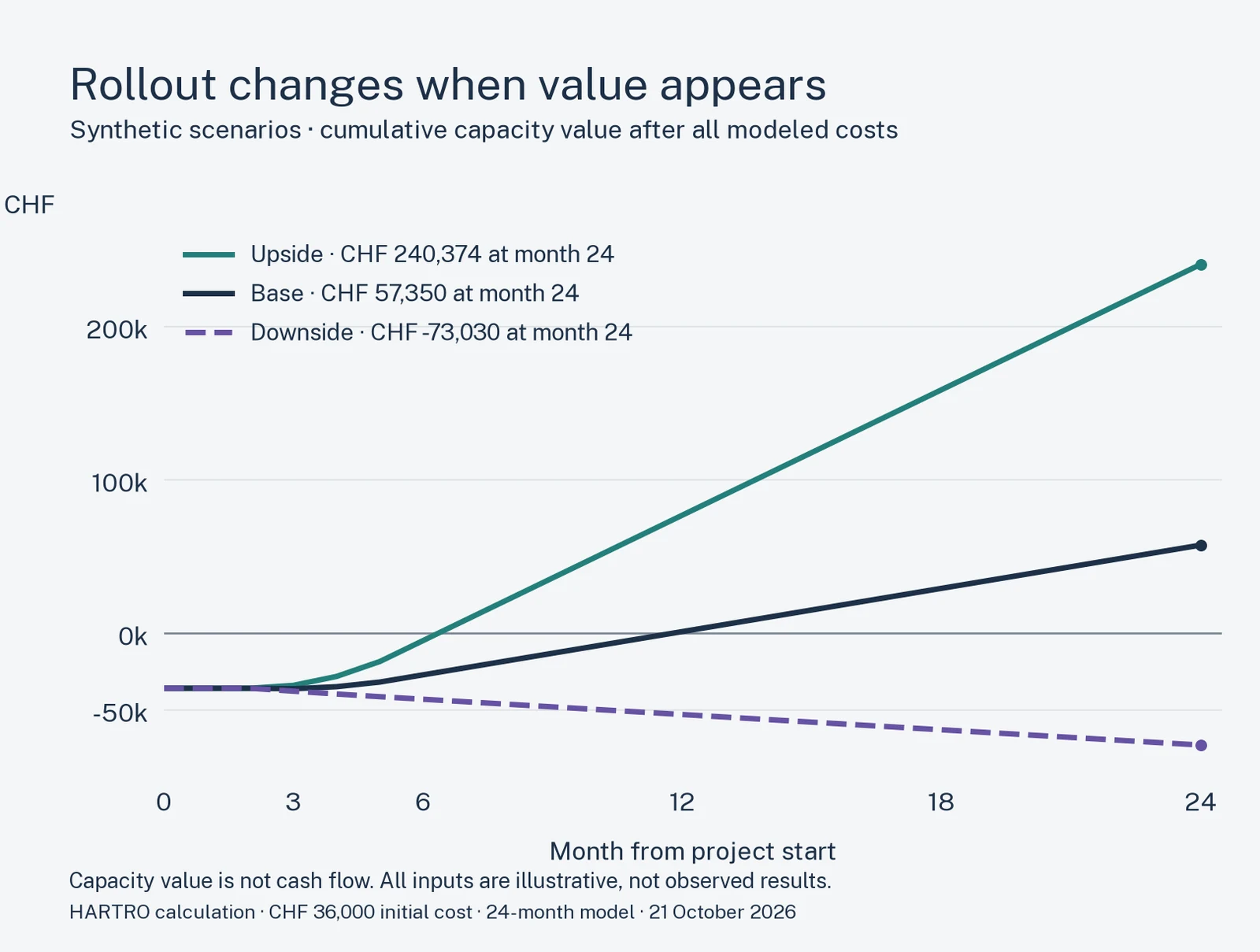
The downside continues losing value even after rollout. Dividing the initial investment by a negative monthly result would produce a meaningless payback claim.
Review time can be decisive without changing any other base assumption. If total assisted effort rises from seven to eleven minutes, net monthly capacity value falls from CHF 4,700 to −CHF 1,060. At the assumed adoption and realization, recurring costs alone break even at about 10.3 assisted minutes per case. Recovering the initial investment within a chosen horizon requires a stronger result.
Use the pilot to replace the uncertain inputs
The business case should identify its largest unknowns: suitable volume, actual adoption, review and correction effort, operating cost, and the work that will absorb released capacity. Measure difficult cases alongside routine ones, and separate gains caused by the change from shifts in demand or staffing.
Evaluating an AI pilot turns those questions into a decision about continuing, changing or stopping. A credible pilot may show that the business case does not work. Learning that before funding a larger rollout is useful.
For a specific opportunity, bring one workflow and its least reliable assumption to an AI workflow assessment. That is a practical starting point for deciding what evidence the next investment should buy.
Sources checked on 21 October 2026. All example inputs, scenarios and returns are synthetic; the arithmetic was calculated from the stated assumptions, and no business outcome was measured.